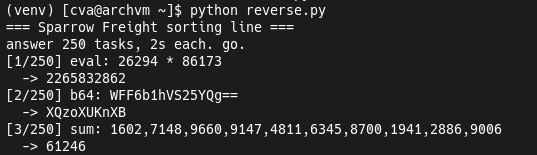
After starting the instance, We are given an interactive server to connect using netcat.
We need to answer 250 questions and each question should be answered within 2 seconds.
the questions are formatted like
[x/250] Operation to perform: input
Even though they are basic mathematical and encoding/decoding problems like Base64 etc.. It is still impossible to answer manually.
So I asked deepseek to write a script to interact with the server to answer the questions based on the operation and input given which are separated by a semicolon.
defnums(data): return [int(x) for x in re.split(r'[,\s]+', data.strip()) if x]
defsolve(op, data): op = op.lower()
# ---- string ops ---- if op == 'reverse': return data[::-1] if op == 'upper': return data.upper() if op == 'lower': return data.lower() if op == 'len': returnlen(data) if op == 'count': returnlen(data) # fallback; see note below if op == 'swapcase': return data.swapcase() if op == 'title': return data.title()
# ---- number ops ---- if op == 'sum': returnsum(nums(data)) if op == 'max': returnmax(nums(data)) if op == 'min': returnmin(nums(data)) if op == 'avg'or op == 'mean': returnsum(nums(data)) // len(nums(data)) if op == 'sort': return','.join(str(n) for n insorted(nums(data))) if op == 'eval': returneval(data)
# ---- encodings ---- if op == 'b64'or op == 'base64': # decode if it looks like b64 of text, else encode try: return base64.b64decode(data).decode() except Exception: return base64.b64encode(data.encode()).decode() if op == 'unb64'or op == 'b64decode': return base64.b64decode(data).decode() if op == 'hex': try: returnbytes.fromhex(data).decode() except Exception: return data.encode().hex() if op == 'unhex': returnbytes.fromhex(data).decode() if op == 'rot13': return codecs.encode(data, 'rot13') if op == 'url'or op == 'urldecode': return urllib.parse.unquote(data) if op == 'urlencode': return urllib.parse.quote(data) if op == 'bin'or op == 'binary': return''.join(f'{ord(c):08b}'for c in data) if op == 'ord': return' '.join(str(ord(c)) for c in data) if op == 'chr': return''.join(chr(int(x)) for x in data.split()) if op == 'md5': return hashlib.md5(data.encode()).hexdigest() if op == 'sha1': return hashlib.sha1(data.encode()).hexdigest() if op == 'sha256': return hashlib.sha256(data.encode()).hexdigest()
# ---- math ---- if op == 'factorial': import math; return math.factorial(int(data)) if op == 'sqrt': import math; returnint(math.isqrt(int(data))) if op == 'pow': a,b = nums(data); return a**b if op == 'mod': a,b = nums(data); return a % b
# ---- fallback: don't crash, log it ---- print(f"!!! UNKNOWN OP: {op} | data={data}") return data # send it back unchanged just to keep going
# banner whileTrue: line = recvline() print(line) if'go.'in line: break
for i inrange(250): line = recvline() print(line) m = re.match(r'\[\d+/\d+\]\s+(\w+):\s+(.+)', line) ifnot m: print("Unparsed:", line) break op, data = m.group(1), m.group(2) ans = solve(op, data) print(f" -> {ans}") sendline(ans)